
Two months. That's how long the average budget survives in my experience — mine included. I once built a spreadsheet so detailed it had 41 categories, conditional formatting, and a color-coded projection for the next five years. I abandoned it in week three because I'd forgotten one thing: payday wasn't the same date every month.
That's the whole gap, really. Most advice on how to create a monthly budget that actually works ignores the fact that months aren't identical. A 5-week month has an extra Friday. Your rent falls on the 1st, your salary hits the 2nd. And that beautiful template you downloaded? It doesn't know any of this.
What follows is the version I've used for the past four years, after throwing out two earlier attempts. It's not beautiful. It works.
Key Takeaways
- Anchor your budget to pay dates, not to the calendar month. A 5-week month behaves differently from a 4-week one.
- Three to five spending categories beat twenty. Fewer lines means fewer places to hide.
- Build in a buffer line of 5–10% for the invisible stuff: subscriptions you forgot, a fridge that dies.
- Reconcile weekly. Five minutes on Sunday beats two hours of guilt on the 30th.
- If you can't remember what you spent, your budget is fiction. Track for one month before you commit to numbers.
Why most monthly budgets fail before the second month
Here's the thing nobody tells you: budgeting isn't a math problem. It's a behavior problem wearing a spreadsheet costume. You can build the most accurate projection in the world and still abandon it, because the tool doesn't survive contact with real life.
Three failure modes I've watched repeatedly, in my own files and other people's:
- The over-engineered grid. Twenty categories sound thorough. In practice you spend ten minutes deciding whether a pharmacy run counts as "health" or "personal care," and after four days you stop opening the file.
- The static estimate. You set "groceries: $480." But some months have five shopping weekends and a birthday dinner. That $480 is a wish, not a number.
- The forgotten non-monthly expense. Car insurance, annual subscriptions, the dentist. If it doesn't appear every 30 days, it vanishes from the plan entirely — until it hits.
The 5-week month problem
Count the Fridays in a typical year. You get 52. Divide by 12 and you get 4.33 — meaning roughly four months a year carry a fifth payday if you're paid weekly or biweekly. If your budget assumes four, those months feel like a windfall, and you spend them like one.
I started splitting my annual fixed costs by 12 and adding a reserve line specifically for the fifth-week months. Boring fix. Eliminated about 80% of my "where did that go" moments.
Building the budget: a step-by-step that survives real life
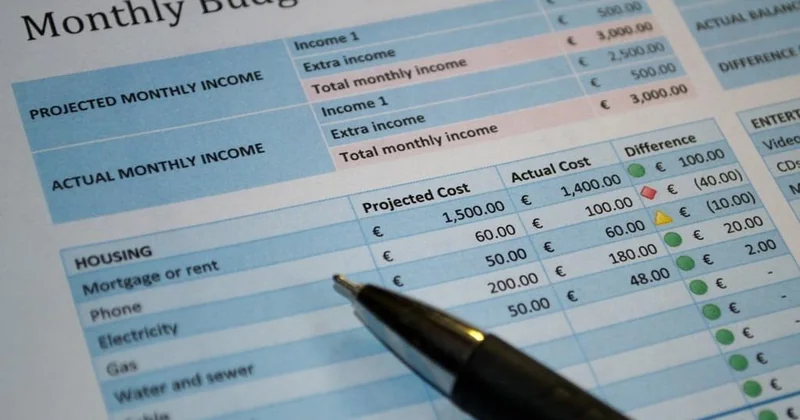
Before you write a single number, you need one month of honest data. Not what you think you spend. What you actually spent. Pull the last 30 days of transactions from your bank and card.
Step 1: total your real income, not your gross
Take-home pay. After tax, after any automatic deductions. If your income varies (freelance, tips, commission), use the lowest month of the last six and treat anything above it as a bonus, not a baseline.
A mistake I made for two years: budgeting on my average month. The average never arrived. The lean months did.
Step 2: split fixed and variable, and never mix them
Fixed costs are the same every month. Rent, insurance, loan payments, phone plan. Variable costs fluctuate. Groceries, fuel, eating out, kids' activities.
| Type | Example | How to budget it |
|---|---|---|
| Fixed | Rent: $1,200 | Exact amount, same line every month |
| Semi-fixed | Utilities: $90–$160 | Use the highest of the last six months |
| Variable | Groceries: $380–$540 | Set a cap, not a target |
| Periodic | Car insurance: $600 twice a year | Divide by 12, save monthly |
| Buffer | Unknown | 5–10% of income, untouchable |
The buffer line is the one people skip. It's also the one that keeps the whole thing alive. Without it, a $200 surprise turns your month into a failure, and a failed budget gets deleted.
Step 3: cap categories, not transactions
You don't need to log every coffee. You need a ceiling per category. If "eating out" gets $150 a month, you can spend it however you want — three nice dinners or fifteen sad sandwiches. That's your call.
This is where tracking apps earn their keep, but honestly, a notes file works too. The tool matters far less than the weekly check.
Step 4: reconcile every Sunday
Five minutes. Open the numbers, compare to the plan, adjust. Not monthly. Weekly. By the time a month has gone wrong, you've already spent the money. Weekly, you catch it in day four.
What a simple personal budget actually looks like
People searching for a simple personal budget example often want a page of numbers. Here's mine, roughly, on a take-home of about $4,200:
- Rent and utilities: $1,450
- Groceries: $520 cap
- Transport: $280
- Debt payments: $400
- Savings and buffer: $700 (yes, this is a line, not a leftover)
- Everything else — eating out, clothes, subscriptions, gifts: $850
Two things to notice. Savings comes before discretionary spending, always. And the "everything else" number is one lump, not fourteen tiny lines. I tried the fourteen-line version. It lasted eleven days.
What a non-example of a budget looks like
You've probably seen one without realizing it: a spending plan that lists what you'd like to spend rather than what you can. "Dining: $200" when your last three months averaged $410. "Entertainment: $50" when you have two streaming subscriptions and a hobby. Those aren't budgets. They're wishes with headings.
A real budget starts from what happened, not from what should have happened. If your actual numbers feel embarrassing, that's information, not failure.
Common questions about monthly budgets
How many categories should a monthly budget have?
Between three and seven, plus a buffer. Any more and you spend your energy categorizing instead of deciding. If you want granularity, do it inside a category — sub-lines for groceries vs. household supplies, for example — but keep the top level small enough to see on one screen.
Should I use an app or a spreadsheet?
Whichever one you'll actually open on a Sunday. Apps automate the importing and do the math; spreadsheets require manual entry but let you shape the logic. I've used both. My longest-running setup was a plain sheet, because the friction forced me to look at the numbers instead of trusting a dashboard to do it for me.
What if my income changes every month?
Budget from your floor, not your ceiling. Use the lowest of the last six months as your baseline. Anything beyond that goes to savings or debt first, before it gets absorbed into lifestyle. Variable income rewards discipline more than stable income does, because there's always more to spend.
The part nobody puts in the template
The template isn't the problem. Neither is the app, the spreadsheet, or the number of categories. The problem is that a budget only works if it reflects a decision you've already made about what you want your money to do.
My first two budgets died because they were attempts to control spending. The third one — the one still running — was an attempt to fund something specific. That's a different relationship with the same numbers.
So before you open another file: what's the one thing this money is for? If you can answer that in one sentence, the rest is just arithmetic. If you can't, no template on earth will save you.